 WhatsApp
Indonesia’s Muslim fashion market is among the largest in the world — and the barrier to entry is lower than most people assume. You don’t need a factory, a design team, or hundreds of millions of rupiah. You need the right strategy and the right manufacturing partner.
Here are the 8 steps to starting a Muslim fashion brand from zero, with real numbers.
Step 1: Define Your Niche and Target Market
A brand that tries to sell to everyone usually sells to no one. Narrow it down:
- Product: instant hijab? premium pashmina? gamis? inner-wear?
- Segment: students? working women? young mothers? religious communities?
- Price position: budget, mid-range, or premium?
An example of a sharp niche: “comfortable premium bergo for working women, mid-range pricing.” From that one sentence, your product, pricing, and content decisions become far easier.
Check the 2026 hijab trends to see where market demand is heading this year.
Step 2: Choose Your Business Model
Three main ways to work with a manufacturer:
| Route | In short | Best for |
|---|---|---|
| Private label | Ready products + your brand label | Beginners — lowest risk |
| OEM / Full Package | Your design, factory does everything | Brands with their own product vision |
| CMT | Your fabric, factory sews | Experienced players |
We compare these in depth in Private Label vs OEM vs CMT. For first-timers, our recommendation is almost always the same: start with private label, graduate to OEM once you have sales data.
Step 3: Calculate Your Capital
A realistic private label budget (excluding marketing):
- Sample: Rp 300,000 (fully credited to your first PO — effectively free)
- First production run: an example 5 kodi (100 pcs) — from ±Rp 3.3 million for viscose pashmina
- Branding: logo, label design, product photos — Rp 500K–2M depending on DIY vs. hiring out
Realistic total: ±Rp 4–6 million to own 100 pcs of product carrying your own brand, ready to sell.
The full scenario breakdown (including OEM and CMT) is in How Much Capital & MOQ Do You Need for a Hijab Brand?
Step 4: Choose Your Manufacturing Partner
The most consequential decision on this list. Minimum criteria:
- Long track record — a manufacturer that has survived multiple market cycles
- Multi-layer QC — ask about the process; concrete answers signal well-run operations
- Sufficient capacity — able to keep up as your orders grow
- Transparency on MOQ, pricing, and lead time — if a simple price question gets a runaround, keep looking
The full evaluation guide: How to Choose the Best Muslim Apparel Manufacturer for Small Businesses.
Step 5: Always Order a Sample First
Never skip this. A sample is the cheapest insurance against a large loss.
At Tiga Raga, the sample commitment fee starts at Rp 300,000 and is fully credited to your first Purchase Order — meaning for clients who proceed, the sample is effectively free.
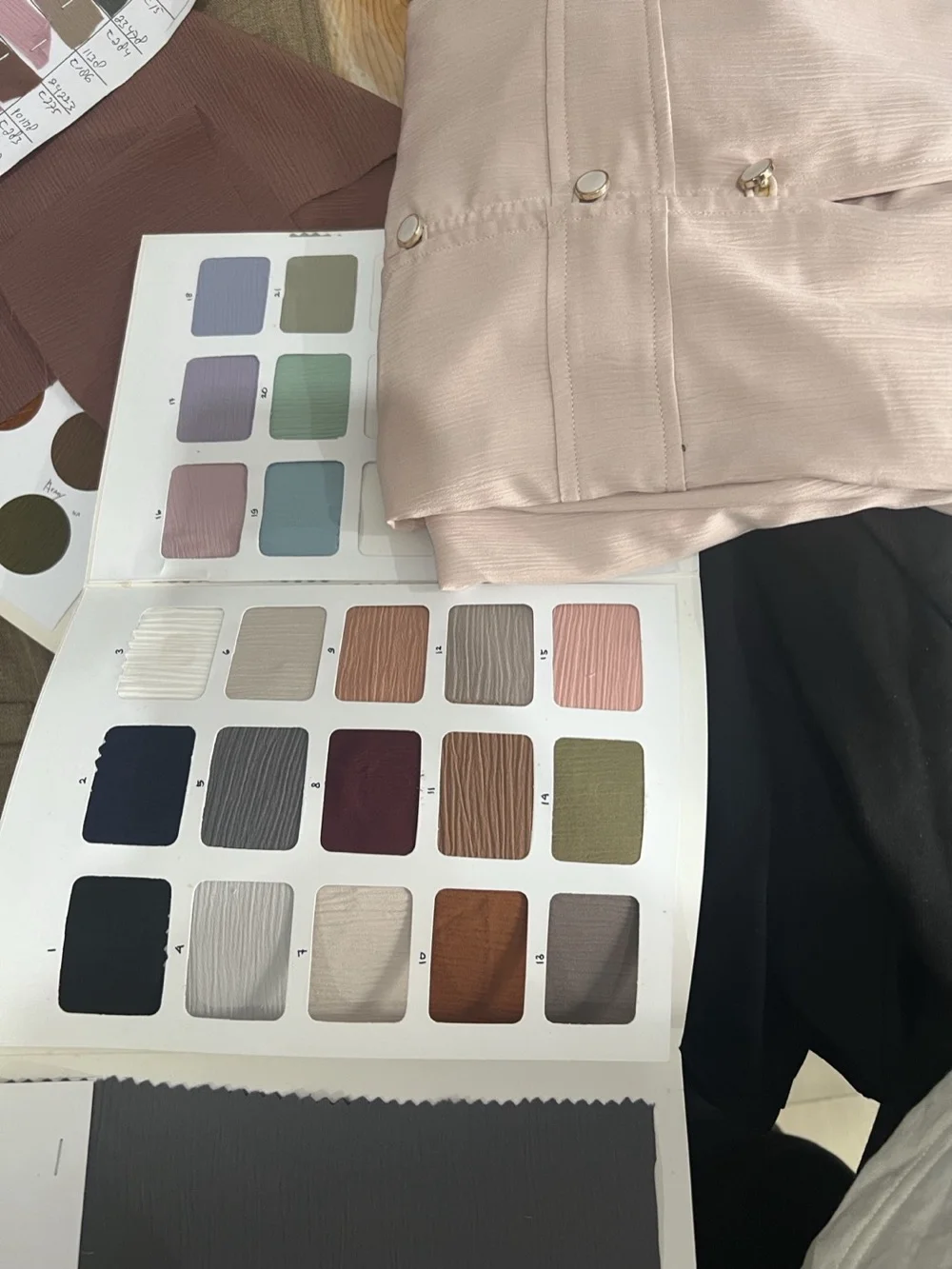
What to check when it arrives: stitching quality, fabric accuracy, color fidelity, and the packaging itself.
Step 6: Build Your Brand Identity
Once the sample is approved, prepare your brand elements:
- Name + logo — simple and memorable beats complicated
- Label — woven or printed, sewn into the product
- Hangtag — the swing tag carrying your brand
- Packaging — custom packaging makes the unboxing feel premium
All four are part of our private label package — including individual retail-ready packaging, so products arrive sell-ready with no repacking.
Step 7: Soft Launch
Don’t wait for perfect. Validate with a small launch:
- Instagram + TikTok — production-process and product-detail content performs well in this niche
- Marketplaces — Shopee/Tokopedia to capture existing search demand
- WhatsApp — answer inquiries fast; response speed is conversion
- Your inner circle — communities, colleagues, religious groups — your first buyers and your first testimonials
The goal of a soft launch isn’t big profit — it’s data: which products get asked about, which colors sell out first, which prices nobody haggles on.
Step 8: Manage Repeat Orders and Scale
Brands live on the second purchase. After launch:
- Keep quality consistent — at Tiga Raga, 98% of our clients reorder; consistency is why
- Restock on data — double down on what’s proven, don’t guess
- Add SKUs gradually — 1–2 new styles per quarter is enough
- Graduate to OEM — once you have a customer base, your own designs bring better margins and differentiation
Start This Week
Eight steps can sound like a lot — but the first one is simple: define your niche, then order a sample.
- Browse the product catalog with wholesale starting prices per kodi
- See the full process on How to Order & Pricing
- Contact our team on WhatsApp for a free consultation
Tiga Raga Konveksi has partnered with 100+ brands across Indonesia and Malaysia since 2004 — from first-time owners ordering their first 5 kodi to brands now ordering thousands of pieces monthly.